Antioxidant Polymer Additives: Complete Guide to Grades, Benefits & Uses
Why every plastic processor needs a reliable antioxidant package - and how to pick the right grade for PP, PE, PVC and engineering polymers.
What Are Antioxidant Polymer Additives?
Every polymer begins to degrade the moment it is exposed to heat, oxygen and mechanical shear during processing. This oxidative breakdown shows up as discolouration, brittleness, cracking and loss of mechanical strength - problems that can ruin an otherwise perfect batch of finished plastic parts. Antioxidant polymer additives are specialty stabilizers blended into the resin before or during processing to interrupt this oxidation chain reaction and protect the polymer at every stage, from extrusion and injection moulding to years of outdoor or industrial service.
At Siya Polymer & Speciality Chemicals, our antioxidant range covers the industry-standard grades - 1010, 168, B215, 1098, 1076 and B225 - so processors working with PP, PE, PVC, ABS, engineering plastics, compounds and recycled polymers can select a package matched precisely to their processing temperature and end-use requirement.
Primary vs Secondary Antioxidants - Why You Need Both
Primary antioxidants (phenolic types such as grade 1010 and 1076) act as radical scavengers, neutralising free radicals as soon as they form inside the polymer chain. Secondary antioxidants (phosphite types such as grade 168) decompose hydroperoxides before they can trigger further chain-breaking reactions. Used together in a synergistic blend, primary and secondary antioxidants deliver far better long-term protection than either type alone - which is why most professional compounders specify a phenolic/phosphite combination rather than a single additive.
Key Benefits for Processors
- Prevents thermal-oxidative degradation during extrusion, injection moulding and blow moulding
- Reduces yellowing and discolouration in natural and light-coloured compounds
- Maintains mechanical strength, elongation and impact properties over the product's service life
- Improves melt stability, reducing scrap and rework at the processing stage
- Extends outdoor and industrial service life of finished components
Where Antioxidants Are Used
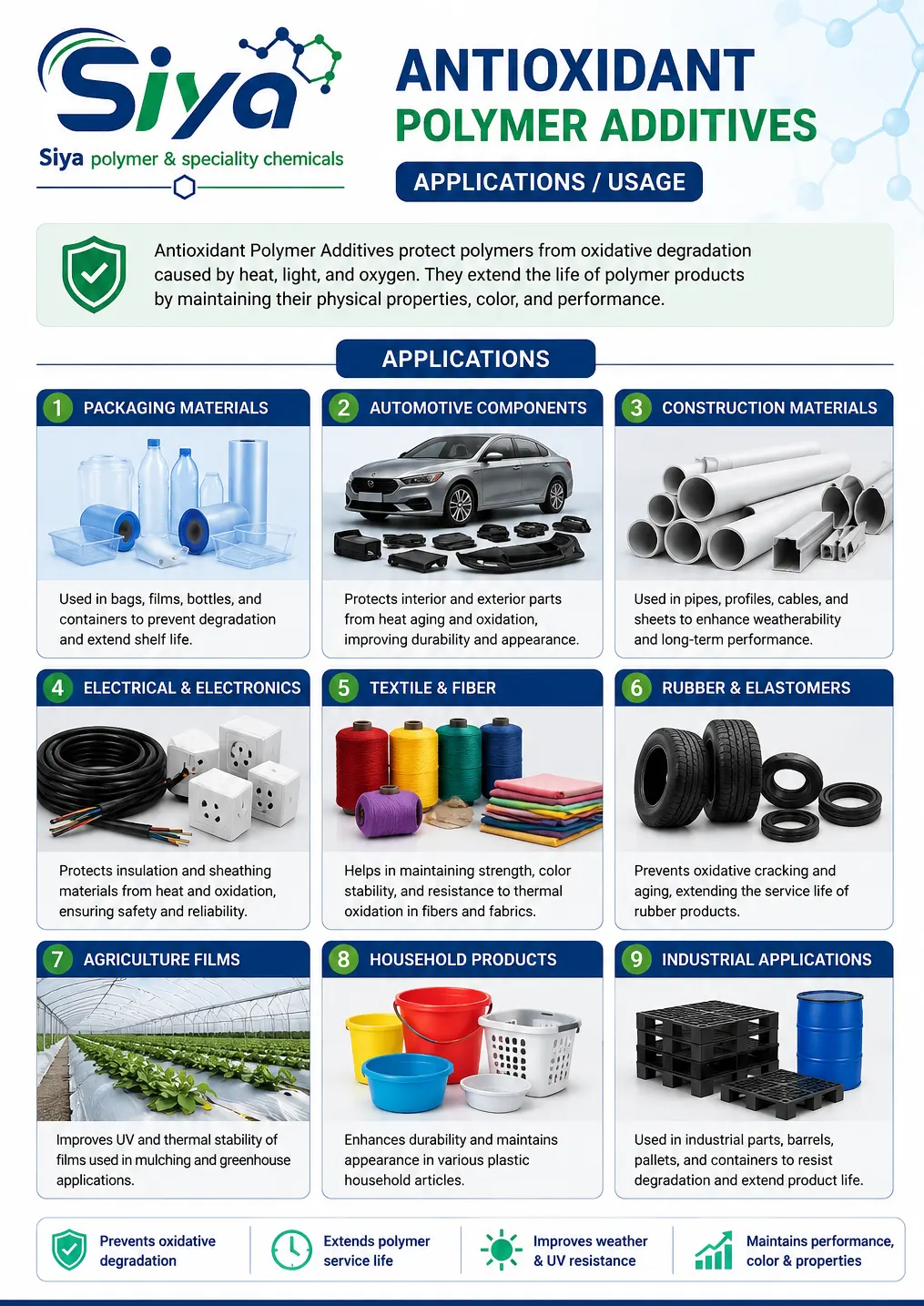
Antioxidant additives are essential in packaging films, pipes and fittings, automotive under-the-bonnet components, electrical and electronic housings, agricultural films, woven sacks, masterbatches, compounds and recycled polymer processing - anywhere a polymer is exposed to repeated heat cycles or long-term outdoor use.
Choosing the Right Antioxidant Grade
The correct antioxidant dosage and grade depends on the base resin, processing temperature, number of reprocessing cycles and the expected service environment. Recycled and multiple-pass materials generally need a higher antioxidant loading than virgin polymer. Our technical team helps customers across Pune, Chhatrapati Sambhajinagar, Nashik, Dhule, Jalgaon and the rest of Maharashtra select and dose the correct antioxidant package for their exact application, rather than relying on a generic one-size-fits-all blend.
Get technical grade recommendations, pricing and samples from Siya Polymer & Speciality Chemicals.
View Antioxidant Polymer Additives Products & Enquire →