How to Choose the Right Flame Retardant Grade for Your Application
The wrong flame retardant grade either fails compliance testing or compromises mechanical properties - here's how to narrow down the right one before you order.
Start With the Standard You Need to Meet
Flame retardant selection should start with the compliance requirement, not the additive - electrical enclosures, construction materials, automotive interiors and consumer electronics are typically tested against different fire-safety standards, and the required additive loading and chemistry follows from that standard.
Halogen-Free vs Halogenated Flame Retardants
Halogen-free flame retardants (such as phosphorus- or nitrogen-based systems) are increasingly preferred because they generate less smoke and fewer corrosive/toxic gases when burned, and many global markets and OEMs now require halogen-free compliance by default. Halogenated systems can be highly effective at lower loadings but are being phased out of many applications due to environmental and smoke-toxicity concerns.
Match the Flame Retardant to the Base Resin
Flame retardant chemistry has to be compatible with the base polymer - a system optimised for polypropylene will not necessarily work as effectively in polyamide or polyethylene, since different resins have different burning behaviours and require different char-forming or gas-phase mechanisms. Always confirm the FR grade is validated for your specific base resin.
Loading Level and Its Trade-Offs
Higher flame retardant loading generally improves fire performance but can reduce mechanical properties (impact strength, tensile strength) and increase material cost and density. The goal is the lowest loading that reliably passes your required test, not the highest loading available - over-specifying wastes cost and can hurt part performance.
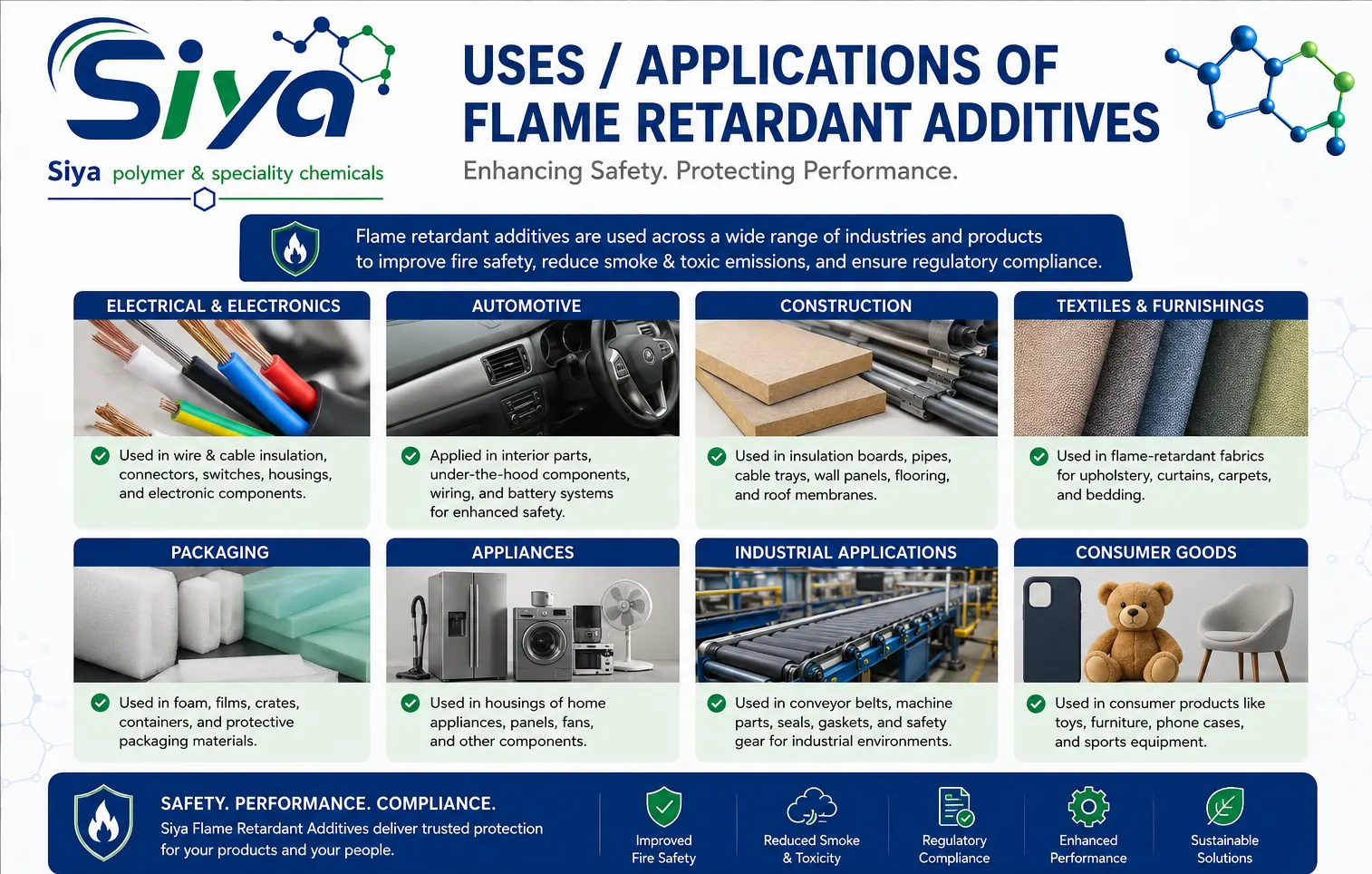
Common Applications and Typical Direction
- Electrical enclosures & connectors: typically need UL94 V-0/V-2 rated, often halogen-free FR systems
- Automotive interior components: increasingly require halogen-free FR due to OEM sustainability mandates
- Construction & building materials: often need low smoke, low toxicity FR systems for occupant safety
- Wire & cable compounds: commonly use halogen-free FR for reduced smoke in enclosed spaces
Testing Before Committing
Because FR performance depends on the interaction between the additive, the base resin and part geometry (wall thickness affects burn testing outcomes), it's worth running a validation sample against your actual target standard before finalising a production order - not just trusting a generic datasheet loading percentage.
Share your base resin and target compliance standard with Siya Polymer & Speciality Chemicals for a grade recommendation.
View Flame Retardant Additives & Enquire →