PP Coupling Agent (MAPP): How It Boosts Strength in Filled & Reinforced Compounds
Understanding compatibilizers and why they are the missing link between polypropylene and the fillers or fibres inside it.
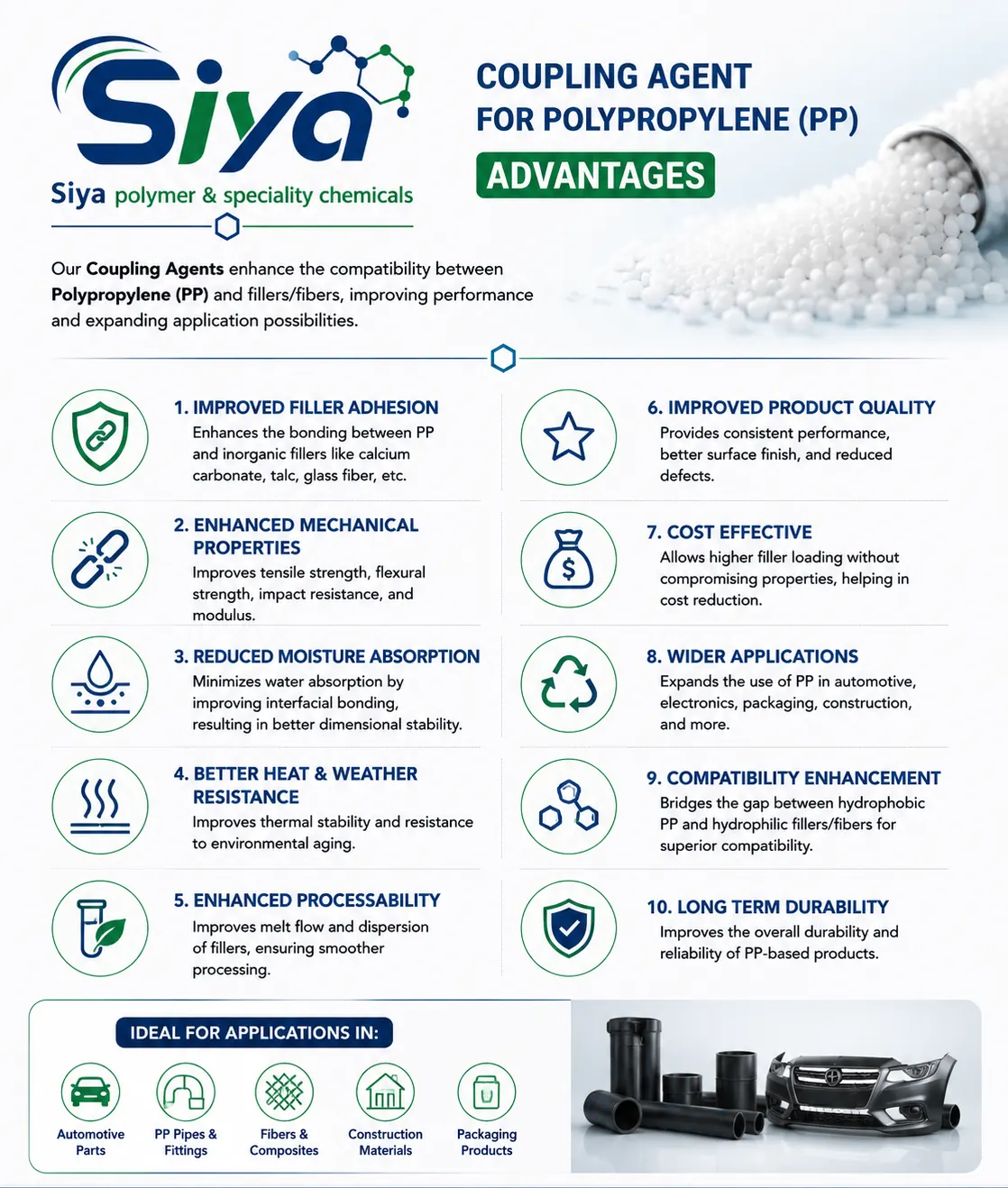
What Is a PP Coupling Agent?
Polypropylene on its own is naturally non-polar, which means it does not bond well with polar fillers and reinforcements such as glass fibre, talc, calcium carbonate, wood flour or natural fibre. A coupling agent for PP - typically a maleic anhydride grafted polypropylene (MAPP) - acts as a molecular bridge between the polymer matrix and the filler surface, dramatically improving interfacial adhesion.
Siya Polymer & Speciality Chemicals supplies coupling agents engineered for glass-fibre reinforced PP, talc-filled PP, calcium-carbonate-filled PP, natural-fibre composites and engineering thermoplastic blends.
How Coupling Agents Improve Compound Performance
- Stronger interfacial bonding between PP and filler/fibre surfaces
- Higher tensile strength, flexural modulus and impact resistance
- Better dimensional stability and reduced warpage
- Improved filler dispersion, giving a smoother surface finish
- Retained processing efficiency despite higher filler loading
Applications
PP coupling agents are widely specified in automotive interior and under-the-bonnet parts, electrical enclosures, appliance housings, construction products and industrial mineral-filled or fibre-reinforced compounds where mechanical performance cannot be compromised.
Choosing the Right Coupling Agent
Selection depends on the type and percentage of filler, the required mechanical performance and the processing method (injection moulding vs extrusion vs compounding). Our technical team helps compounders across Maharashtra match the correct MAPP grade and dosage to their exact filler system.
Get technical grade recommendations, pricing and samples from Siya Polymer & Speciality Chemicals.
View Coupling Agent for PP Products & Enquire →